
Artificial Intelligence and Publishing: Torino Book Fair Conference 2026
On 13 May 2026, the day before of the 38th edition of the Turin International Book Fair, I had the opportunity to attend the second edition of the conference «Artificial Intelligence and Publishing», organized by Torino’s Salone Internazionale del Libro in partnership with OGR Torino. The event brought together publishers, technologists, distributors and sector operators for an afternoon of working sessions that marked, in the organizers’ own words, a decisive turning point: from theory to practice.
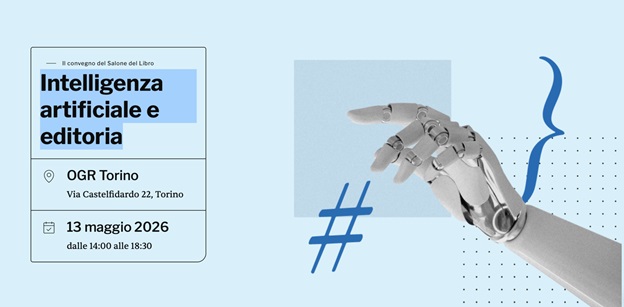
While the first edition, in 2025, had the character of an opening conversation — a moment to understand what was happening — this year’s conference deliberately chose a different register. The question was no longer whether artificial intelligence is changing publishing (the answer is by now self-evident), but how it is doing so: with what tools, what precautions, and what implications for those who produce and distribute content.
The proposed approach was explicitly «strategic and practical»: distinguishing between useful experiments and overhyped solutions, understanding what is workable today and what still requires caution, and analyzing AI’s impact on rights, responsibilities and workflows.
The publisher’s role in the age of AI
The first address in the plenary session, delivered by Andrea Angiolini (Managing Director of Il Mulino and AIE delegate for Innovation), centered on a fundamental question: what remains of the traditional publisher’s role in an ecosystem where machines read, write and comment?
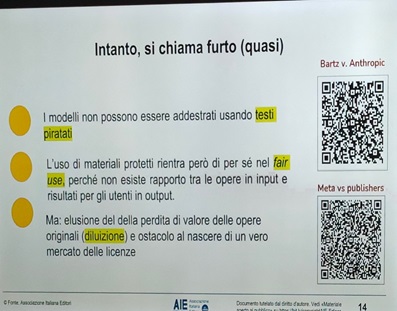
The answer was not a nostalgic defense of the profession, but a reaffirmation of its strategic centrality. On the regulatory front, Angiolini framed the ongoing transformations within the context of Italian and European copyright law: contractual terms, licensing models and editorial policies are all shifting. The legal framework is still evolving, but publishers cannot wait for it to stabilize — they need to act with awareness right now.
The challenges ahead: navigating a market in transformation
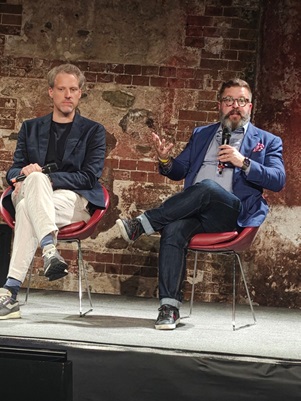
The roundtable with Michael Tamblyn (CEO of Rakuten Kobo) and Jens Klingelhöfer (CEO and co-founder of Bookwire) offered a privileged view of AI’s impact on distribution dynamics at international scale.
One of the sharpest observations to emerge from the roundtable was the growing competition between authentic author content and what Michael Tamblyn bluntly described as «AI slop» — a flood of low-quality, algorithmically generated material now crowding digital shelves and threatening to erode reader trust. For platforms like Kobo and Bookwire, this raises an urgent and still unresolved question: how do we disclose, clearly and consistently, what has been written by a human and what has been produced or significantly assisted by AI?
 Both speakers argued that standardization and greater transparency in AI labelling are not just ethical imperatives but strategic ones — tools to protect and enhance the perceived value of genuine human creation. At the same time, they were careful to resist a purely defensive framing: the benefits that AI brings to the publishing chain are real and should be acknowledged, not dismissed. The challenge is not to reject AI, but to govern it — ensuring that the services and features built around a book, whether recommendation engines, audio enhancements or personalized reading experiences, enrich rather than disrupt the act of reading or listening.
Protecting creators, building smarter organizations
Beyond the reader experience, Tamblyn and Klingelhöfer turned to the less visible but equally consequential question of how AI is reshaping the economics and internal culture of publishing organizations. On the commercial side, both called for a renegotiation of licensing structures — arguing that authors and publishers need better-framed deals that reflect the new realities of AI-driven content distribution and protect their rights in an environment where their works may be used to train or augment AI systems. Internally, the conversation pointed to the importance of clear employee policies governing the use of AI in daily work routines. Far from being a bureaucratic concern, such policies were framed as a positive instrument: when staff understand where AI can assist and where human judgement remains essential, organizations are better positioned to use technology in a way that amplifies, rather than replaces, human input. The consistent thread running through both contributions was the same: AI is most valuable in publishing when it is deployed deliberately, transparently, and in service of the people — authors, editors, readers — at the heart of the industry.
A recurring theme in this part of the debate was content discovery: with AI filtering, recommending and summarizing, the ways in which readers find books are changing. Platforms that integrate AI intelligently into recommendation systems gain significant advantages in engagement and conversion.
In sum, AI will create more services around authors and publishers ‘content to facilitate curation, discovery, filter and distribution, as well as to create new monetization channels (licensing).
Which AI for which publisher?
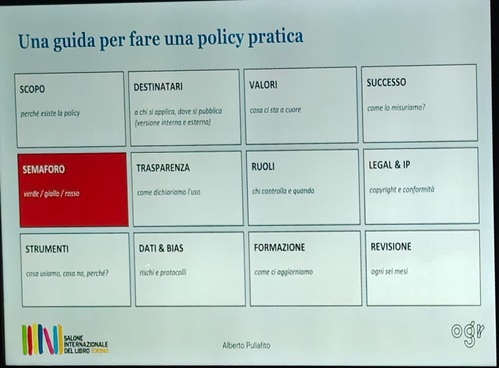
Before the break, the most practical contribution of the day came from Alberto Puliafito — journalist, media analyst, founder of Slow News and author of Artificiale for Internazionale — who offered a hands-on guide to integrating AI tools into editorial processes.
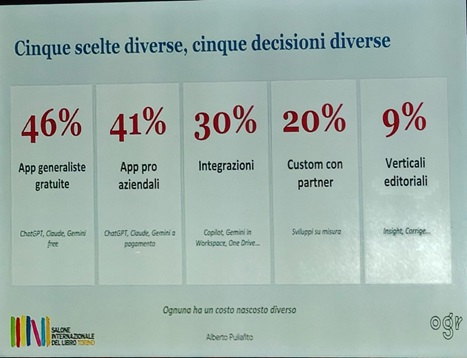
The central question was: how do you choose? The AI tools market is saturated and rapidly changing. Puliafito drew a distinction between the thoughtful use of open generalist models — well suited to many everyday needs when guided with competence — and the adoption of vertical, specialised solutions, which is only justified when workflows are structured enough to require it and the expected benefits are measurable.
The underlying message was not necessary to adopt every technological novelty, but it is necessary to start testing tools, processes and results.
The afternoon concluded with parallel workshop sessions divided by publishing segment: fiction, general non-fiction, children’s books, and academic/essay publishing. Each group was led by a publisher and a technologist, with the aim of tackling concrete cases, testing tools and comparing selection criteria based on the specific organizational reality and workflow of each publishing area.
The conference confirmed that the Italian publishing sector has entered a new phase in its engagement with artificial intelligence: past the stage of wonder and fear, the work now is on concrete choices. The professionals gathered in the conference left not with universal answers — there are none — but with better understanding of the upcoming implications of AI in the publishing sector.